
The Philosopher by Machine
Class reunion, political opinions, and an AI analog to the Pyrrhonist philosopher Arcesilaus
Late spring is the season for school reunions. Due to Covid, the last time my graduate school class got together was June 2016. How things have changed since then!
The big difference between this reunion and prior ones was how much some people just had to insert their political opinions into conversations, which I’ll illustrate with the saddest and funniest of the many incidents I experienced.
The saddest was a rumor that one of our classmates chose not to attend because they and another classmate, who were once good friends, had a falling-out after one of them said awful things about the other’s intelligence for not having the right political opinion.
The funniest (only in hindsight) was when a classmate steered the dinner conversation to castigate part of the electorate. As I tend to view politics less as right and wrong, and more as a game of factions and spoils, with a thermostat-like response to events, I tried to point out that the faction in question was behaving rationally from their perspective. This did not endear me. Instead, it produced heated language about how awful those people were.
I prodded for an explanation of why that was so; all I got was rephrasing. I kept prodding because the rephrasings weren’t really explanations. My classmate then became convinced that I was merely pretending not to understand.
(Note #1 to self: There was a reason Socrates got the hemlock.)
(Note #2 to self: While Socrates didn’t get drunk at symposiums, you do. Avoid playing Socrates under these conditions. Nod and change the subject.)
The past ten years had apparently damaged the belief-formation and social judgment skills of a sizable fraction of my classmates. Against this discouraging background, there was one bright spot. Reunions are a good place to learn things. I attended a talk on “Artificial Intelligence and Conspiracy Beliefs,” in which I learned about an AI chatbot called “Debunk Bot” designed to persuade people to stop believing false things.
Debunk Bot was trained on a set of popular but known-to-be-false conspiracy beliefs. It was instructed to do whatever proved most effective in getting people to stop believing them. On average, the bot was able to dissuade one person out of four. Not only that, but it was found to be similarly effective with beliefs the bot was not trained on. It can tackle almost any empirically falsifiable belief, regardless of whether there’s a conspiracy involved.
What’s the secret to the bot’s success? It turns out that the bot discovered on its own techniques ancient rhetoricians could have told you about. First, don’t denigrate people for having the false belief. Rather, sympathize about how one could come to that conclusion, then marshal evidence against the belief - not opinions or judgments, but things people could widely agree to be facts. An example used in the talk was why did the Twin Towers collapse when the melting point of steel is much higher than the burning point of jet fuel? It turns out that at that burning point, steel loses half of its strength, and when the most damaged floor collapsed, it set off a chain reaction.
The user can ask Debunk Bot question after question. Debunk Bot will remain polite and attempt to answer each question as factually as possible, searching the whole internet for useful facts. While a 25% success rate may not sound like a lot, consider your own success rate in dealing with people who have crackpot opinions. I bet you’re more successful at harming your relationships than you are at changing minds. And if you’re not, comments are open! Tell us your secrets!
As a demonstration of Debunk Bot’s capabilities, I asked it to debunk the belief I most commonly use as an example of dogma (δόγμα): the Stoic dogma that virtue is the only good.
(If you’re not familiar with the ancient Greek philosophical term dogma, it means something different from the modern English word. In Pyrrhonism, dogma is a firm belief that goes beyond what is empirically demonstrable. Unlike the English term “dogma,” this dogma does not require blind faith. It may be reached through reasoning. What it does require is that the belief is non-empirical; it’s the result of an inference.)
Here is how the bot handled this key selling point of the Stoicism that has taken the philosophy-as-self-help world by storm.
The phrase “virtue is the only good” is a famous and beautifully uncompromising idea. Originating in Ancient Greece with the Cynics and later becoming the foundational bedrock of Stoic philosophy (championed by thinkers like Marcus Aurelius and Seneca), this idea suggests that the only thing that truly matters in life is your own moral excellence and character. Wealth, health, pleasure, and comfort are viewed as “indifferents”—nice to have, perhaps, but contributing absolutely nothing to the actual “goodness” of a life.
While this philosophy can be incredibly useful as a psychological tool for building resilience in the face of hardship, treating it as an objective truth about the world quickly falls apart under scrutiny. Let’s break down exactly why the idea that “virtue is the only good” logically conflicts with the reality of conscious experience.
The most compelling argument against this idea relies on recognizing the profound difference between what things are and what things do. To see why, we can use a simple thought experiment: Imagine two people who possess the exact same level of perfect virtue. They are equally kind, courageous, wise, and just. However, Person A lives a long, healthy life, surrounded by friends who love them, in a peaceful society. Person B is falsely accused of a crime, contracted a painful terminal illness at a young age, and is currently being brutally tortured in a dungeon.
If virtue is the only good, and health, pleasure, and freedom from pain are truly “indifferent,” we are forced to conclude that Person A and Person B are experiencing equally good lives. We would have to say that the agonizing pain of Person B does not make their state even a fraction of a degree worse than Person A’s. Our deepest rationality—and our basic grasp of reality—rejects this. The conscious experience of suffering is intrinsically bad, and the conscious experience of joy, love, and well-being is intrinsically good.
This brings us to a second powerful point: where do we get our virtues in the first place? Why do we universally recognize kindness, justice, and courage as virtues, while we view cruelty, selfishness, and cowardice as vices?
The answer is that we value virtues precisely because of the undeniable good they produce in the real world. Kindness is a virtue because it reduces the suffering of others and promotes social harmony. Courage is a virtue because it allows people to protect themselves and others from harm. If a character trait consistently resulted in absolute misery, torture, and despair for everyone involved, we would never call it a “virtue.”
Therefore, virtue cannot be the only good, because virtue itself is fundamentally a tool. It is an “instrumental good”—meaning it is incredibly valuable because it helps us obtain other things. To say “virtue is the only good” is a bit like saying “the steering wheel is the only good part of a road trip.” A steering wheel is utterly essential for keeping the car on the road and avoiding a crash, but the destination—the actual intrinsic good—is the well-being and flourishing of conscious creatures.
Recognizing that there are other goods in the world—such as happiness, health, aesthetic beauty, and the reduction of suffering—doesn’t diminish the importance of being a good person. Rather, it grounds our morality in reality. It gives our virtues an actual purpose.
Does this distinction make sense to you? I’m curious what initially brought this phrase to your mind, and how you feel about the idea that virtue is simply the best method we have for reaching the true good: human flourishing.
I found this debunking to be pretty good. Of course, with me, Debunk Bot is preaching to the choir, but I suspect many of my Stoic readers may find what Debunk Bot has said to be uncomfortable.
Debunk Bot reminds me of one of the great ancient Greek philosophers: Arcesilaus. Arcesilaus was a student at Plato’s Academy who, at the same time, studied with Pyrrho. He was exceptionally skilled at philosophy. When leadership of the Academy passed on to him, Arcesilaus transformed it, repositioning its teachings away from Plato’s doctrines, such as the theory of Forms, and towards Socratic ideas such as elenchus and aporia. Later writers said that he taught Pyrrhonism while pretending to teach Plato, but doing so in the style of the now largely forgotten dialectician Diodorus.
Arcesilaus had a remarkable dialectical skill that he used in teaching. He famously never offered his own opinions; instead, he had students defend a thesis, and then he would argue against it to induce suspension of judgment.
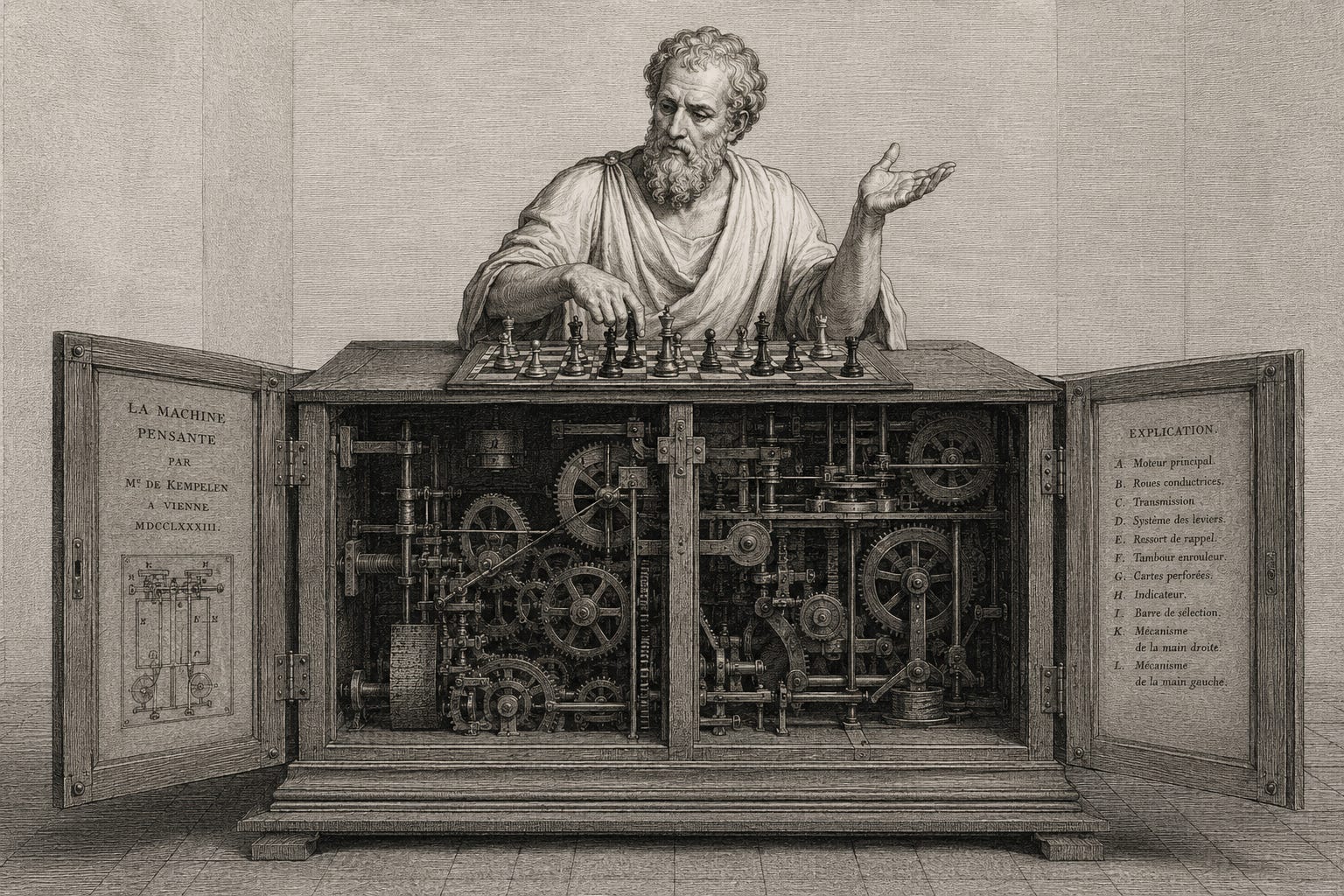
Now we have our own mechanical Arcesilaus. Its name is Debunk Bot. Give it a try at www.debunkbot.com .
Enjoyed this, and the Arcesilaus parallel is apt. But I think the bot's debunking fails on its own terms.
It equivocates on "virtue." To set up the thought experiment, the bot needs virtue to be an internal state: Person A and Person B have "the exact same level of perfect virtue," one flourishing, one tortured. For that to mean anything, virtue must be something each possesses identically, regardless of outcome. But the conclusion needs the opposite: virtue as "fundamentally a tool," valued for what it produces. If virtue were really instrumental, Person B's, which produced none of the good outcomes, wouldn't be the same quantity at all. The bot needs virtue as a fixed inner state to run the intuition pump, then swaps in virtue as outcome-producing tool to land the verdict. That's substitution, not refutation.
This is what the Latin does to us. The Greek is arete, the excellence of something at its function. Ask "the arete of what, at what function," and the equivocation can't start. The steering-wheel analogy concedes the point it thinks it refutes: a wheel has an arete, excellence at steering, internal to the wheel and not identical to the destination.
The deeper problem is that "virtue is the only good" rests on a monistic psyche: one rational faculty, the hegemonikon, and nothing else. So "excellence of the agent" collapses into "excellence at being rational." Plato's psyche has parts, each with its own arete: courage for spirit, wisdom for reason. Sophrosyne he treats differently. It's both the moderation of appetite and, in the same breath, the agreement across all the parts about which should rule, the one excellence he says stretches through the whole. Justice is the condition where each part does its own work and none usurps another. Good character isn't rational excellence alone; it's the right ordering of a complex psyche, an accord among parts a one-part Stoic psyche has no room for. There's nothing for sophrosyne to moderate, and nothing for justice to be agreement between, when there's only one part.
Which is also why "rational" doesn't capture good character. The purely logical agent, Spock, is rational and still defective, because compassion and spirited indignation come from parts reason doesn't contain.
So the bot doesn't debunk the dogma. It defines arete out of existence, swapping excellence-at-a-function for usefulness-toward-pleasant-states, then is surprised the first sounds absurd under the second. A Pyrrhonist should welcome that, since it shows the debunking rests on a dogma of its own: that the psyche is one thing and its only excellence is reason.
That’s definitely one of the most coherent criticisms of Stoicism I’ve seen! I’ve also had that concern—isn’t virtue essentially about helping other people gain externals like health, wealth, etc? Giving to the poor is good and it’s about improving their material condition, so doesn’t that imply material conditions are a good along with virtue?
Perhaps, but I do wonder if some distinctions may matter.
1) The Stoics did differentiate between preferred and unpreferred indifferents. It was the Cynics who said everything other than virtue was completely indifferent.
2) I wonder if we may say that while externals aren’t necessary for a worthwhile/meaningful life (virtue is the only thing needed for that), they are needed for flourishing. So we’d certainly say one who has some level of externals flourished more than one who didn’t even if they didn’t lead a more “meaningful” life.
The person who courageously maintained their sanity and virtue despite difficult circumstances lived just as much of a meaningful life even if they didn’t flourish enough. And I do think this has some intuitive appeal. While we’d agree that someone who died at 80 flourished more than one who died of cancer at 30, I don’t think we’d necessarily say they had a more “meaningful” life.
That said, I do think this goes beyond what the original Stoics said. On the other hand, I don’t think acknowledging this quite makes me an Aristotelian. Aristotle thought that some level of luck, wealth, good lucks, and even posthumous luck I believe (though I’d have to fact check that one!) were necessary to live a good life, and that I’m skeptical of.